Everyone Wants AI, But What Does AI Need?
Artificial Intelligence is no longer a futuristic concept; it is actively transforming industries ranging from aerospace manufacturing to clinical research. When organizations discuss implementing AI, the conversation almost always centers around complex neural networks, predictive models, and cloud automation.
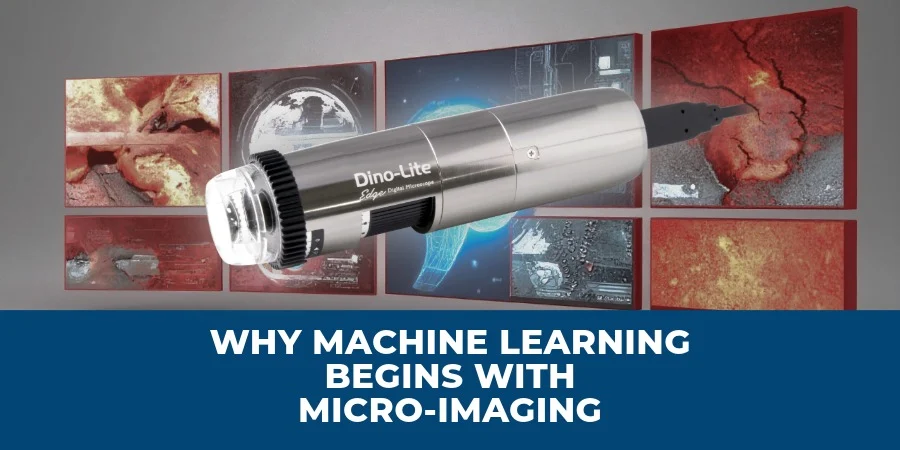
However, there is a fundamental truth that every data scientist knows: every AI system is only as good as the data it is fed. For visual AI applications, such as automated defect detection, material classification, and surface analysis, image quality directly dictates the success of the entire system. Before an algorithm can think, a reliable imaging system must see. This is exactly where Dino-Lite digital microscopes fit into the modern AI workflow.
The AI Pyramid: Why Data Comes First
To understand the role of digital microscopy in automation, it helps to look at the “AI Pyramid.” At the very peak of the pyramid sit advanced AI applications and machine learning models. But those models cannot exist without the levels beneath them: rigorous training, validation, and, at the absolute baseline, Data Collection.

AI models learn strictly by example. If a dataset consists of low-resolution, blurry, or inconsistently lit images, the resulting AI will produce unreliable, unpredictable results. Consistent, repeatable image acquisition is essential. Before an AI can accurately identify a micro-crack on a circuit board or classify a biological sample, a high-quality digital microscope must capture that ground-truth image data.
Bridging the Physical World and the Digital Dataset
Dino-Lite digital microscopes can act as a bridge between tangible physical components and the digital datasets that power machine learning. In industries like electronics, medical devices, materials science, and quality assurance, microscopes are used to build comprehensive image libraries.
These libraries serve two major purposes:
- Automated Inspection: Training models to detect anomalies, spot manufacturing deviations, and flag areas requiring human review on items like precision-machined components or consumer products.
- Classification and Sorting: Teaching AI systems to recognize and categorize items based on visual characteristics, such as distinguishing surface finishes or verifying component authenticity.
Furthermore, this creates a loop of continuous improvement. As production lines change or new anomalies emerge, new microscopy images are seamlessly fed back into the training datasets, allowing the AI model to refine its accuracy over time.
Beyond the Desktop: Integrating Microscopes into Automated Robotic Systems
To achieve the level of repetition that machine learning requires, organizations are increasingly integrating digital microscopy units into automated hardware systems. A primary example of this is mounting compact digital microscopes directly onto the end-of-arm tooling of collaborative robots (cobots) and robotic arms.
By utilizing our Software Development Kit (SDK), software developers and automation engineers can integrate the microscope’s controls directly into their proprietary automation platforms. A robotic arm can be programmed to precisely maneuver a microscope over a target, automatically trigger an image capture under identical lighting and focus constraints, and instantly feed that image to a localized AI model for real-time pass/fail evaluation.
Why Precision Imaging Features Matter to an Algorithm
When building an image library for AI, standard consumer imaging tools often fail because they lack control. Dino-Lite digital microscopes provide specific, highly controllable features that make visual data “machine-readable”:
- Lighting Control & Polarization: Glare and reflections from metallic or glossy surfaces can confuse an AI model. Anti-glare polarization ensures the AI sees the actual surface details, not a reflection.
- Extended Depth of Field (EDOF): For components with complex geometries or varying heights, EDOF features clear up background and foreground blur, ensuring the entire object is in sharp focus for the algorithm.
- Software Calibration & Digital Readouts: Leveraging units that feed the exact magnification data directly to the software, the AI or automation system can dynamically adjust its scaling matrix in real time.
Looking Ahead: AI Needs Better Data, Not Just Bigger Models
As artificial intelligence continues to evolve, the race is no longer just about building bigger models, it is about securing better data. Organizations looking to deploy AI-driven workflows must prioritize their image acquisition tools from day one.
So, when evaluating your hardware options, don’t just ask, “Can this microscope do AI?” The more accurate question is: “Does your AI have the image quality it needs to succeed?” Dino-Lite digital microscopes ensure that your machine learning models are built on a foundation of clarity, precision, and repeatability.